 Universitas Padjadjaran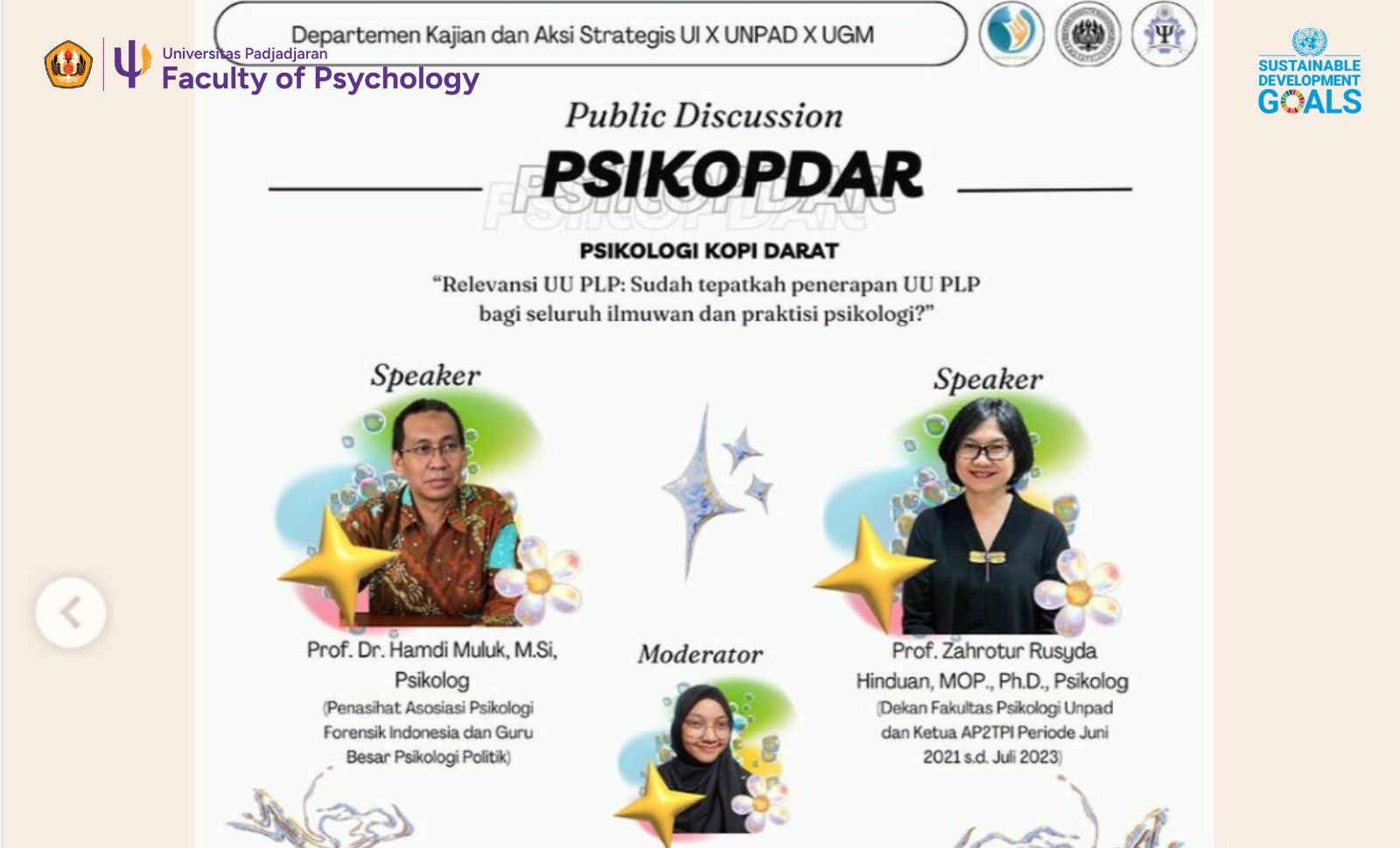
Strategic Studies Department of BEM Fapsi Unpad Holds Open Discussion on the Relevance of the PLP Law in the Psychology Profession
Author Kinanthi AL
The Strategic Studies Department of BEM Faculty of Psychology Padjadjaran University held an open discussion entitled “Psikologi Kopi Darat: The Relevance of the PLP Law – Has the Application of the PLP Law been Appropriate for All Psychological Scientists and Practitioners?”.
This event aims to discuss various confusions and questions that arise among psychology scientists and practitioners regarding the newly implemented Psychology Service Practice Act (PLP Act).
This discussion presented two main speakers, namely the Dean of the Faculty of Psychology Unpad, Prof. Zahrotur Rusyda Hinduan, MOP., Ph.D., Psychologist, and Prof. Dr. Hamdi Muluk, M.Si. Psychologist, an Advisor to the Indonesian Forensic Psychology Association as well as a political psychology expert from the University of Indonesia. Both discussed various important aspects of the implementation of the PLP Law and its impact on psychological scientists and practitioners in Indonesia.
This event was organized by Strategic Studies Department of BEM Fapsi Unpad in collaboration with Strategic Studies Department of BEM Faculty of Psychology, University of Indonesia (UI) and fully supported by the Indonesian Psychology Student Association (ILMPI). As an organization that houses psychology students throughout Indonesia, ILMPI supports this activity to strengthen the role of students in national development, especially in the field of psychology. BEM Fapsi Unpad itself is part of ILMPI.
In the discussion, various questions regarding the implementation of the PLP Law were openly discussed, including its impact on the practice of psychological services in Indonesia. The event also highlighted the importance of fairness and transparency in the implementation of the PLP Law, which is in line with the Sustainable Development Goals (SDGs) point number 16. This point emphasizes the importance of building strong, fair and transparent institutions, and providing access to justice for all.
With this discussion, Kastrat BEM Fapsi Unpad hopes to provide a better understanding of the PLP Law among psychology students and practitioners, and encourage the achievement of SDGs point number 16. This discussion is also expected to be a forum for psychology students to be more involved in public policy issues that impact their profession, as well as strengthen networking and collaboration between universities through ILMPI.