 Universitas Padjadjaran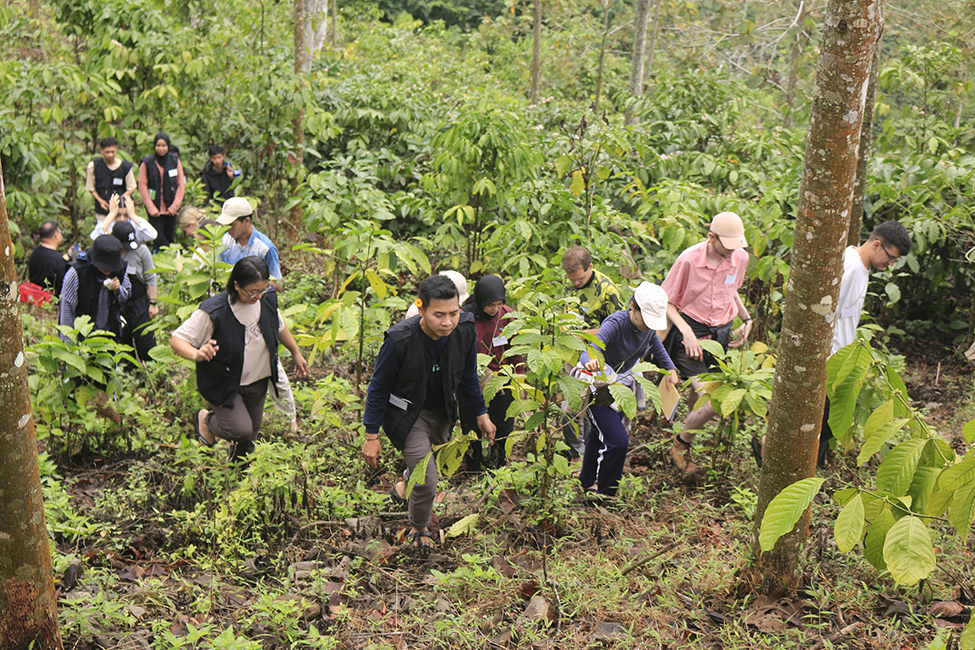
Fapsi Unpad Initiates Psychological Therapy Approach “Forest Healing”
Author Arif Maulana
Forest healing is a therapy that is currently being widely used in the field of psychology. This is also an opportunity for the Faculty of Psychology, University of Padjadjaran to begin introducing forest healing therapy methods, not only for internal students, but also students from outside Fapsi Unpad.
The activity was introduced to participants of the International Internship Program 2024 which was held in the slopes of Mount Mandalawangi, the border of Bandung and Garut Regencies, Wednesday, September 11, 2024 ago. In the activity, as many as nine Royal Melbourne Institute of Technology students, Australia, and five Fapsi Unpad students participated in the activity. This activity is fully supported by PT Pertamina Persero.
Hammad Zahid Muharram, M.Psi, Psychologist, explained that the activity aimed to introduce the program participants that there is a type of psychological therapy that can be used to relieve various types of psychological symptoms, including stress.
“Forest healing cannot cure, because stress healing needs CBT therapy. However, it is a relief, less severe than before,” said Zahid.
Zahid further explained that humans should have a strong bond with nature. When humans are in the forest, they will feel a different microclimate than in the city or outside nature. The microclimate is mostly produced from phytoncide substances that plants release naturally. This substance is considered capable of increasing human health levels while in the wild.
During the forest healing, IIP Fapsi Unpad participants were invited to stay longer in nature. The activity began with a walk into a farming area on a slope directly adjacent to a protected forest area. Uniquely, all participants used flip flops while walking and in the forest.
Guided by Fapsi Unpad Lecturer Noer Fauzi Rachman, PhD, Psychologist, participants walked along the garden track to the border area with the forest. Arriving at the tobacco field area, participants were encouraged to take a moment to mingle with nature. Each participant was asked to be silent for a moment to hear the swish of the wind and the sounds heard in nature.
Afterwards, participants were invited to touch trees, talk to trees, hug trees, pick wildflowers, and enter coffee plantations while tasting coffee cherries. Not finished there, participants were invited to go deeper into the bush and hug and talk to trees again.
At the end of the activity, participants were invited to go down to the river, play with water, and try to catch fish using nets.
According to Zahid, these activities are not without reason. In spirit, humans are part of nature, so when connected to nature, humans automatically return to the scope of human natural ecology.
Like the four elements in the movie Avatar, forest healing also makes participants more connected to the four elements. Zahid explained that when participants walked barefoot, the activity represented a connection with the land.
“Then when they are silent, sitting relaxed while looking at the clouds, the scenery, and breathing in the air element. The fire element is when they talk and hug trees, because fire is a symbol of warmth,” he explained.
The water element is represented when participants jump into the river after walking in the forest. Zahid explained that water is a complement to all the elements that have been connected. No matter how tired the participants are after a long walk in the forest, water can refresh their bodies.
“When we return to the water, we are connected to the source of life,” he explained.
Pilot Project
Zahid said forest healing is a new approach and is starting to be widely used. Most of it is still used by non-psychology people with commercial purposes. It is different if this approach is used by psychology people. All activities while in nature have an evaluation process carried out.
“The difference is, there is processing done, whether the therapy is effective (to relieve stress) or not,” he said.
In Fapsi Unpad itself, this activity is the first project introduced. The plan is that this activity will become one of the services that will be developed by the faculty. “Hopefully, this can become a faculty product,” he concluded. (Photo: Arif Maulana)*